

Media archaeology in art: 3.1 billion views, a hand crank, and the illusion of memory

From Okkult Motion Pictures to The Giphoscope: practicing media archaeology in art to test what survives without an archive or an author.
Long before I began building optical machines, in an early note from my Zibaldone Filosofico titled External Memory, I wrote down a rather simple observation: we have relieved ourselves of the burden of remembering. We have driven memory out of our bodies, exiling it into hard drives, flash cards, and remote servers, deluding ourselves that stockpiling files inside a digital warehouse is the same thing as preserving a culture.
When in 2012 I stopped working with the electron microscopes of Nanoart and co-founded Okkult Motion Pictures alongside Marco Calabrese, the problem in front of me was no longer the invisible. It was its exact opposite: the hyper-visible.
We wanted to test the second great fetish of human centrality—cultural memory and the institutional archive—using the poorest, most disposable format on the web: the animated GIF. Born in 1987 with a cramped palette of 256 colors and engineered to repeat endlessly without resolution, the GIF was everywhere before the eyes of hundreds of millions of people every day, yet for museums and official art registries it simply did not exist. It was not invisible; it was unreceivable.
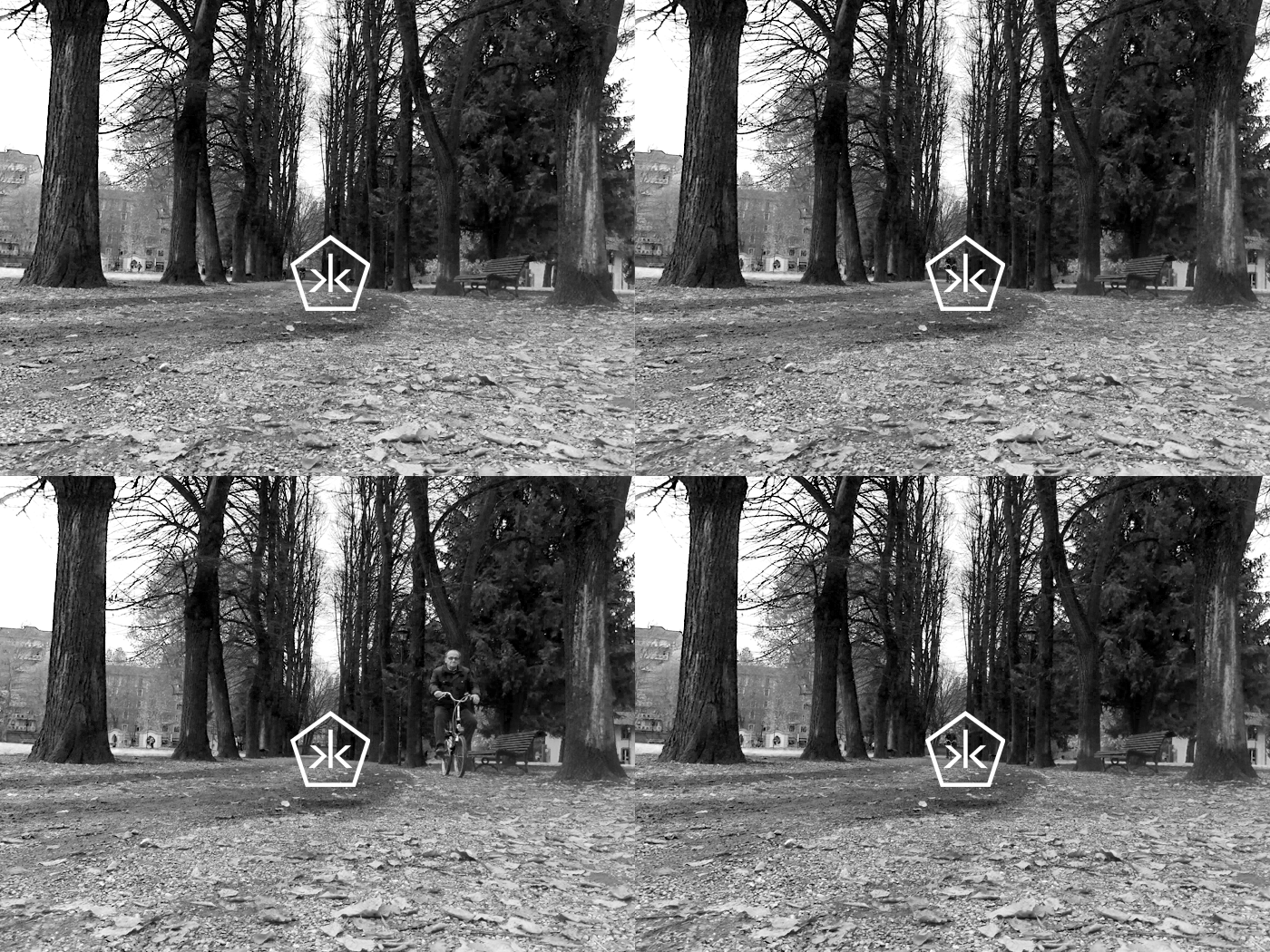
At the time, what struck me most was the philosophical structure of the loop itself. In a 2016 interview on Doppiozero, I compared it to a Dantean contrappasso: isolating a split-second human gesture and condemning the subject to repeat it forever inside a visual cage from which escape is structurally impossible. Trapped in that perpetual motion, the human figure spins in place, stripped of the illusion of progressing toward a goal.

Within a few years, the more than 1,300 loops published on Okkult's GIPHY channel accumulated over 3.1 billion views: a figure exceeding the combined annual attendance of the world's major physical museums.
Yet the truly revealing datum for what I now call the Anthropoperiphery was not the number itself: it was the irrelevance of the author. Millions of people used, copied, and circulated those images every day in their daily conversations without knowing—or needing to know—who had created them. The images took root and survived not despite the absence of a museum and an authorial signature, but precisely because the author had stepped out of the way.
Still, an obvious trap remained: a digital GIF lives on borrowed time inside someone else's servers. A single change in corporate ownership or algorithmic ranking is enough for billions of images to vanish overnight.
The Giphoscope and the practice of media archaeology in art
Out of this fragility, The Giphoscope was born.
Instead of chasing a newer screen, Marco and I stepped back more than a century, returning to Herman Casler's 1894 Mutoscope. We took those ephemeral digital loops and locked them inside an analog machine built by hand in Turin, piece by piece, out of Italian walnut, marble, aluminum, and brass: twenty-four physical frames mounted on a precision roller that does not move on its own. To see the image, you have to step up and physically turn a hand crank.


This exercise in media archaeology in art was neither nostalgic retro-fetishism nor mere design craft ("Analog Fever", as Rob Walker framed it in The New York Times in 2015). It was an empirical test on the threshold of the archive: the exact same looping image that museums ignored as long as it weighed a few kilobytes on a screen, once given physical weight, mechanical slowness, and material resistance, entered the display cases of the Serlachius Museum in Finland (Blink and the triptych LooPorn), MGLC Ljubljana, Tate Britain (1840s GIF Party), and the pages of academic volumes published by Bloomsbury Academic, Barbara Grespi, and Valentina Tanni. The work had not changed; only its specific gravity had.
Then, in 2020, came the most ruthless and coherent epilogue we could have imagined.
Meta acquired GIPHY for one billion dollars. Overnight, with no notification, contract, or preservation clause, the entire Okkult archive—1,300 works and 3.1 billion views—was swallowed into the proprietary infrastructure of one of the largest corporations on the planet, which soon altered its accessibility and search logic.
That epilogue sealed the second axis of the Anthropoperiphery with a precision hard to match: on one side, the institutional guardian (the museum), arriving late as usual; on the other, the human author, convinced of owning his own memory and swept aside in a second by a corporate transaction. In the end, out of all that digital noise, the only fragments left truly beyond the reach of algorithms are those three hundred small hand-cranked machines sitting quietly on tables around the world—waiting for a hand to decide, for a few seconds more, to make them turn.
Read more: https://www.alessandroscali.art/


Comments